Boat Loan Finance Online Bike Loan Repayment Calculator
Calculate motorcycle loan repayments in seconds with our Bike Loan Calculator. Compare finance options and plan your ride with confidence.
Calculator results are estimates based on the inputs and assumptions used and are provided for general information only. They are not quotes, offers, approvals, eligibility decisions or personalised recommendations, and do not indicate that a lender will provide credit.
Bike Loan Details:
Important!
Bike Loan Interest Rates differ from lender to lender and will depend on your individual circumstances (credit history, employment status, age, etc.).
Bike Loan Amortisation Calculator
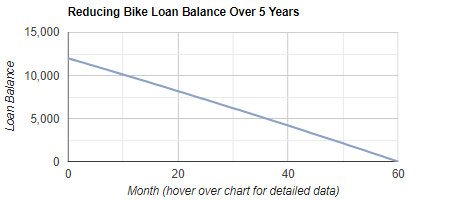
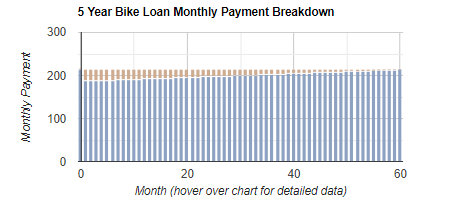
The following amortisation graphs detail month-by-month data on the progress of the proposed loan. The first chart below examines the reducing loan balance over the course of the finance contract term. The second graph illustrates the portion of each monthly repayment allocated to payment of interest vs principal reduction.
How to use our Bike Loan Repayment Calculator
Our Bike Loan Repayment Calculator is designed to estimate your motorcycle loan repayments in seconds, so you can compare bike finance options and plan your budget before you commit. It is important because small changes to loan size, term length and interest rate can materially change your monthly repayment and the total interest you pay over the life of the loan.
This calculator provides estimates only and is not personal financial advice. Results do not take into account your objectives, financial situation or needs. Interest rates and fees vary by lender and your individual circumstances, and your final rate can only be confirmed after an application is assessed.
How to complete the form for the best result:
1. Purchase Price
Enter the bike purchase price as a whole number (no dots or commas). If you expect to borrow extra for on-road costs such as stamp duty, registration or insurance, include those amounts in the figure you enter so the estimate better reflects your likely loan amount.
2. Deposit or Trade-in Value (if applicable)
Enter your deposit or trade-in value as a whole number. If you have no deposit, enter 0. A higher deposit generally reduces the amount borrowed and can reduce interest paid over time.
3. Term of Loan (Years)
Select a term between 1 and 7 years. Longer terms typically reduce monthly repayments but can increase the overall cost of the loan due to more interest over time. Choose a term that fits your cash flow, not just the lowest repayment.
4. Interest Rate (% per annum)
Select an interest rate for the simulation. If you are unsure, test a conservative higher rate to see whether repayments remain affordable.
5. Calculate
Click calculate to generate your estimated repayment and amortisation visuals.
How to interpret the results:
1. Repayment estimate
Use the repayment figure as a starting point for budgeting, then stress-test by increasing the rate or reducing your deposit to see how sensitive repayments are.
2. Amortisation graphs
Review the loan balance chart to understand how quickly you reduce what you owe, and the interest versus principal chart to see how much of each repayment goes to interest compared with reducing the loan balance over time.
Boat loan repayments are usually based on the amount borrowed, interest rate, loan term, repayment frequency, fees and any balloon payment. Understanding these inputs can help Australian boat buyers use repayment calculators more confidently and compare finance scenarios. - read more
When it comes to buying a boat, choosing between a new and a used one is a significant decision that can impact your finances in multiple ways. A boat is not just a pleasure craft; it's also a considerable investment that requires careful thought and planning. - read more
Before financing a used boat in Australia, buyers should understand PPSR searches, clear title, security interests, HIN checks and how existing finance can affect settlement. - read more
Welcome to the thrilling journey of buying your first boat! Owning a boat is a dream for many Australians, offering the promise of sunny adventures and endless horizons. - read more
Grass-fed cattle producers have narrowly backed an increase in the national cattle transaction levy, turning an industry governance debate into a practical budgeting issue for livestock businesses. The vote, reported after Meat & Livestock Australia’s annual meeting in Townsville, approved lifting the levy from $5 to $6 per grass-fed animal sold, with the higher rate expected to begin from 1 July 2028 if linked transparency and reporting reforms are in place. - read more
A fresh national survey of Australian grain growers is putting autonomous machinery back on the finance agenda, not because every farm is ready to buy driverless equipment, but because the gap between interest and affordable adoption is becoming harder to ignore. - read more
ABC Landline reporting on 14 November 2026 has highlighted a South Australian push to commercialise battery-powered trailers that could reduce diesel use in heavy transport without requiring operators to replace prime movers. For Australian farm businesses, the development is worth watching because freight, haulage and on-farm logistics are increasingly part of the same machinery and cash-flow conversation as tractors, headers, loaders and irrigation assets. - read more
Fresh reporting on mortgage stress has put a practical but often misunderstood issue back in front of Australian homeowners: asking a lender for hardship assistance can be the right step when repayments become unmanageable, but it may also change the way a future refinance is viewed. With higher variable rates flowing through household budgets after the Reserve Bank’s November move, the distinction between short-term repayment relief and longer-term borrowing flexibility is becoming more important. - read more